Thursday, November 17, 2022

Brook Trout Eggs Arrive, Brown Trout Develop into Alevins

Brown trout eggs were delivered to classrooms across the Cayuga and Seneca Lake watershed mid-October, marking the kickoff of DCL’s 2023 Trout in the Classroom Program. Throughout the school year, elementary school students will raise trout in tanks inside their classrooms, observing different phases of the trout’s life cycle through interactive experiments. By Spring, when trout develop into the Fingerling stage, students will release their trout into streams and creeks around Seneca and Cayuga Lake, where they will continue to grow and make their way into the lake where trout can live in the adult phase for 9-10 years.

Brown trout eggs were distributed to classrooms ranging from Watkins Glen to Union Springs and as far south as Newfield, NY. As the eyes were clearly visible in the trout eggs upon receiving them from the DEC Hatchery in Bath, NY, it was expected for the eggs to hatch any day. Classrooms reported within days of the eggs arrival, Alevins began appearing as trout started growing outside their yolk sack, still connected to their bellies. The Alevin stage lasts for 3-4 weeks, as trout take on more of a tadpole-like appearance with large heads connected to a tail. At this stage, they are still feeding from their yolk sack as they grow and develop their gills, fin and their digestive system. When the yolk sack is fully absorbed, trout move into the Fry stage where they start swimming to the surface to look for food. 


At the hatchery where the trout eggs were collected, the process of harvesting eggs simulates what is natural occurring outdoors. Female fish full of eggs are put under anesthesia before the eggs are stroked from their belly. Sperm is then taken from the male trout and combined with the eggs and finally water is added to activate the fertilization process. 

This mimics what is happening in nature, as male and female trout will make their way to a streams for the spawning process, where they build a nest, or a “redd” in shallow water with medium-sized rocks sufficient for moving around to protect the 500-1,000 eggs laid by the female. Males will then step in to fertilize the eggs during the process. 

Last week, DCL gathered brook trout eggs from the SUNY Morrisville Hatchery and delivered those eggs to the remainder of 25 schools hosting aquariums for the Trout in the Classroom Program. We will be working with about 1500 students and 60-plus classrooms this year. To find out more about schools involved with the program, read our latest Trout in the Classroom Blog post.


Eventually, trout will grow to the Fingerling stage, which, as you would guess, is about the size of a finger. This will be the size they reach by Spring time when its time to release the trout into streams, so they can continue to grow in the wild.

Learn more about Discover Cayuga Lake’s Educational Programs and our mission of educating kids and community members the importance of being a mindful citizen within a watershed ecosystem.

Monday, November 7, 2022

Trout in the Classroom is IN SESSION!

The Finger Lakes Trout in the Classroom program is up and running, with more partner schools than even before!

We've been pretty busy, and are just completing the last of 25 classroom aquarium setups right now.  (We will be working with about 1500 students and 60+ classes this year... whew!)

Brown trout eggs were collected from DEC's hatchery in Bath, NY, on October 14 & 17th by students from Enfield Elementary and South Seneca Elementary.  Over 1500 eggs were then distributed to schools throughout a region spanning from Watkins Glen to Union Springs, and south to Newfield, NY.  

Brook trout eggs will be arriving from SUNY Morrisville's hatchery on Wednesday this week for 9 schools.  AND, our brown trout have already hatched and are completing the "alevin" (or "sac fry") stage of their life cycles.  They are developing right before our eyes, and we will share more about that soon!

We're having a great time visiting classes and meeting everyone, and plan to bring classroom observations, activities and fun to this blog throughout the year!

~Bill, Astrid & Katie

Participating Schools, Fall 2022 to Spring 2023

Dryden Middle & High Schools
Groton Elementary School
Ithaca School District
Belle Sherman Elementary
Beverly J. Martin Elementary 
Caroline Elementary
Cayuga Heights Elementary
Enfield Elementary
Fall Creek Elementary
Northeast Elementary
South Hill Elementary 
Lehman Alternative Community School
Lansing Elementary
       Newfield Middle School
South Seneca Elementary
Trumansburg Middle School
TST BOCES Smith School
Union Springs Middle School                                      Elizabeth A Clune Montessori School  

Special Thanks to All Who Make This Program a Success! 

Trout Unlimited, Leon Chandler Chapter                    Federal Fish & Wildlife Service                                    NYS Dept. of Conservation                                        SUNY Morrisville Fish Hatchery                                  Fantastic Classroom Volunteers                                  Amazing & Creative Teachers!   

Monday, May 16, 2022

Breeding Toads and the Amplexus Position

During a trout release on Wednesday, May 11 in the Salmon Creek at Salt Point, students from TST BOCES Turning Point program were in for a special treat when we discovered a pond filled with breeding toads.

In the Springtime, male and female toads gather in large numbers to breed in small bodies of water with very little movement like ponds, marshes and ditches, which is just what students from Sarah Kunz' class were able to witness first-hand.

In the mating position of toads, called amplexus, the male toad clasps to the female's back and the pair swims around as the female, filled with eggs, selects a site for depositing them. 

Toad eggs are distinguishable from frog eggs because toads lay eggs in long jelly-like strings while frogs lay eggs in a large cluster. Females expel several thousand eggs, with the capacity of releasing up to 30,000 eggs. Males fertilize the egg with their sperm through the amplexus position. 

The jelly surrounding the eggs swell in the water until each egg is covered with a thick coating. The coating allows the eggs to float to the surface of the water where there is more oxygen for the eggs to survive. 

In a few days, a tadpole will hatch from each fertilized egg and over the course of four to six weeks, the tadpole will go through three stages of development- growing longer, growing a body and tail, then absorbing the tail and growing limbs before finally metamorphosing into a small toad. 

Young toads will leave the pond they lived in as tadpoles and may only return to breed again later on.

Trout Release with TST BOCES Turning Point

Schools from across the Cayuga Lake Watershed involved in the Trout in the Classroom program are in the process of releasing trout into creeks and rivers feeding into Cayuga Lake after spending most of the school year raising the trout in their classroom. 


Students from TST BOCES Turning Point program came out to Salmon Creek at Salt Point, where they walked upstream to find a good spot to release their trout. The students first evaluated the quality of the stream by gathering a sample of macroinvertebrates and using the macroinvertebrate identification key to assess the aquatic life before releasing the trout.


In their stream sample, students in Sarah Kunz' class found lots of mayfly larvae, stoneflies and crayfish among the insects living in the creek. All of these macroinvertebrates will eventually be food to the young trout being released, so it was important to first make sure the trout would have enough food to eat. They also use the macroinvertebrates sample as an indicator of a healthy stream life, since insects are dependent on clean water to survive. The class determined that the creek possessed enough biodiversity to make it habitable for the trout to survive in the water, and moved upstream away from their sampling area to release the trout.


Each student got a small container filled with a couple trout that they had raised throughout the year in their classroom. Students gently released their trout into a pool of water just upstream from a swift current and watched as the trout paused for a minute to acclimate, and then swim away to their new home in the wild!


Tuesday, May 10, 2022

Monster Trout

As our classes anticipate releasing their trout over the coming weeks, a little friendly competition is always fun.  Liz McCheyne's fifth grade class at South Seneca Elementary has tossed out the first challenge!

My class is wondering how big your biggest trout is---I'm including a picture of Monster, our tank giant.  He is 15.1 cm and he's a cannibal so we've had to provide lots of cover for his peers. Please send pics of your big ones.

Thursday, May 5, 2022

Tennesee Trout Release!

Spring is here, and our network of schools will be releasing trout to local streams over the next six weeks.  We'll try to post updates and opportunities to observe the fun and learning!

One of our local Trout Unlimited volunteers, Bob Walters, just shared this great article about a Trout in the Classroom program in Tennessee... spring comes earlier down there, and so they are releasing trout before we do. 

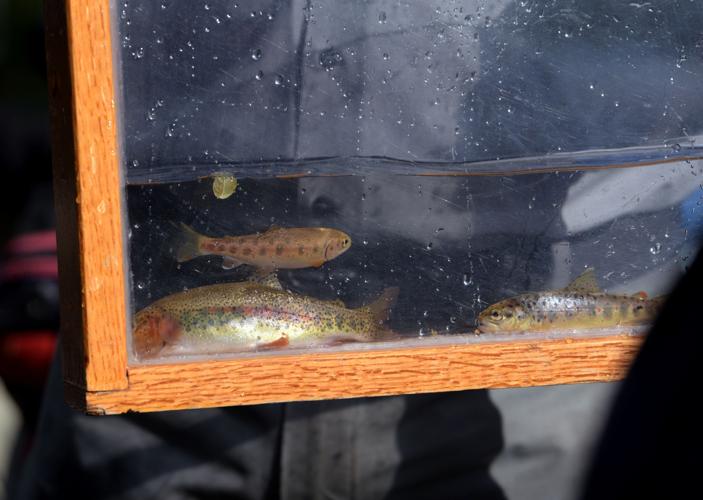
We love some of the adaptations they are using, and my goal is to build a fish observation box, just like this one.  Can you name all three species of trout visible?


Answers:  top fish is a brown trout; lower left is a rainbow and lower right is a brook trout!  (We only raise brown and brook trout in our classrooms.)

Monday, April 11, 2022

Listen to the Frogs!

School is on spring break this week, which means (we hope!) more time to get outdoors and explore.  There's plenty of water filling streams and ponds and vernal pools here in upstate New York, and as the weather warms you'll hear plenty of frogs and toads.  In fact, if you listen closely, you might notice three or four or even five different calls happening all at once!

To help you sort out the chorus, check out Calls of Frogs and Toads of the Northeast, on Lang Eliot's "Music of Nature" website.  Many of these amazing records have beem made right here, around Ithaca.


Wednesday, November 17, 2021

Illustrating the Eggs

Each year, students at Northeast Elementary in Ithaca, NY  raise brook trout.  As will all our Brook Trout classes, they receive eggs in early November but have to wait a week or more for the eggs to hatch.  Here's a great activity to help the time pass.

Master Teacher Paula Kilts (who recently retired and we miss her already!) would introduce scientific illustration... carefully drawing what you see... as a way to begin important observations, and get the creative juices flowing, even before the eggs hatch.


The end result combines careful observation and illustration with a little poetry.  These works will be the first in a series of journaling activities as the trout develop and grow!


Friday, November 12, 2021

Brook Trout Eggs have Arrived!

Brook trout eggs were delivered on November 8, courtesy of our friends at US Fish & Wildlife's Cortland office (thanks Gian Dodici!) and the DEC's hatchery in Morrisville, NY.  


Notice the visible eyes... these eggs will be hatching soon!

Today was a reminder that we've still a ways to go to get back to normal.  The arrival of eggs is usually a boisterous event, with students mobbing the tank, excited and asking lots of questions.  This year, we're still keeping it low key, but we're excited to be visiting classes again! ~Bill F.

Wednesday, November 3, 2021

DO TROUT YAWN?

We'll be publishing interesting questions that come up when we visit classes... sometimes we might even provide an answer!  Here's our first installment, asked by Saatva, and Cayuga Heights Elementary.

Do Fish Yawn?

This is a surprisingly complex question, because we don’t actually know quite how to define a “yawn”.  And that's because we don’t actually know what “yawning” does. 

The most convincing theory currently (many have been disproven over the years) is that yawning serves to cool down the mammalian brain, which fatigues as it warms up. If that is the case, than it is unlikely to benefit fish since, as "ectotherms" - cold blooded animals - their body temperature is controlled by their environment anyway. SO, if that sounds right to you, than the answer would be, "No, fish do not yawn."  BUT, if you are not convinced that yawning cools your brain, and there must be some other explanation… than maybe they do!  Here are some cool pix to help you consider...

(Shout out to www.thenakedscientists.com for great take on this subject.)