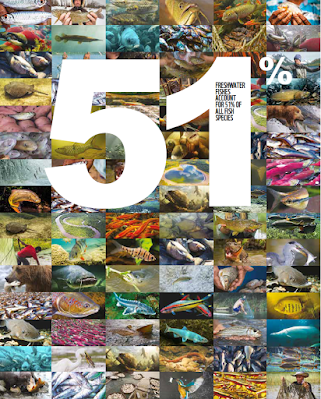
DID YOU KNOW that over half of all fish species live in freshwater?
According to "The World's Forgotten Fishes", a new report by the World Wildlife Foundation, "Freshwater biodiversity is declining at twice the rate of that in our oceans or forests. Indeed, 80 species of freshwater fish have already been declared ‘Extinct’ by the IUCN Red List of Threatened Species, including 16 in 2020 alone. Meanwhile, populations of migratory freshwater fish have fallen by 76 per cent since 1970 and mega-fish by a catastrophic 94 per cent."
Here in the Finger Lakes, we are not seeing many threatened species of fish, or extinctions. That's good. But, we don't even depend on our freshwater fish as a commercial food supply. It turns out however, that around the world, freshwater fisheries provide the main source of protein for 200 million people across Asia, Africa and South America, as well as jobs and livelihoods for 60 million people. Wow!
I know many of you saw our post earlier this week about beginning our live feeding experiments with our trout and are curious to know more about this common zooplankton, Daphnia, that we feed our trout.
Daphnia are a zooplankton, meaning that they are animals (zoo) that live at the water's surface, drifting with the currents (plankton). But daphnia are not just any zooplankton... they can live in incredible conditions!
Studies show that daphnia can live in slightly salty water like you would find where a stream meets an ocean (estuary) and that they manage small levels of salt just as well as completely freshwater! This is incredible. If a human were stranded on a boat in even mildly salty water, they would not be able to survive drinking it because the salt would just make them thirstier - but daphnia can.
A healthy daphnia (left) with a daphnia producing hemoglobin (right).
And here is something even more incredible: if the water source is not changed for the daphnia and they start to use up all their oxygen, they create the same chemical that we have in our blood (hemoglobin) to bind oxygen - making their oxygen intake much more efficient (and turning them slightly reddish colored). That's crazy! Think if you were trapped in your classroom without an air supply and everyone breathing up all the oxygen, pretty soon you would feel super lightheaded, but daphnia have a mechanism to be able to survive days longer in an environment without a lot of oxygen.
If you think that is cool, just wait until you get to watch a trout chase a daphnia around a glass in our feeding experiments. We will have videos and more results of our live feedings coming by the end of next week, stay tuned!
You can check out more about daphnia through our worksheet and a slideshow shared by our teacher program on the teachers' tab of this blog.
Our young trout have grown to a size of about 2 or 3 centimeters. Are they ready to hunt and eat living prey? At this point in the year, classes are ready to conduct their first "live food" feeding experiments, using a common zooplankton, called "Daphnia".
First, students have a chance to practice observation skills, as they get to know the "costar" of this experiment. Daphnia are about the size of a sesame seed.
Then, student research teams prepare their hypotheses and perform an experiment to see how their trout will respond to an opportunity to try a new food... that just might try to escape! Usually, our staff is on hand to lead this experiment (we love it!) but we'll be assisting virtually this year! Here's a quick glimpse into how it goes...
Finally, students evaluate their results and compare with other research teams. Here is a typical chart that depicts how many daphnia are eaten by trout during 20 second intervals over five minutes.
Interesting... for more on this lesson and teaching materials, click on the "For Teachers" tab!
Here's a cool project for MIDDLE SCHOOL students! New York State Dept. of Environmental Conservation has announced their 2021 "Protect Our Watersheds" Poster Contest.
Top 14 entries will be published in the NY DEC's 2022 Calendar, sent all over the state. One student per poster. Deadline for receipt of posters is Friday, February 5, 2021. See the Details HERE.
And, to sweeten the pot, we're select one or two entries and create banners to fly from the MV Teal this summer on Cayuga Lake!
Your friendly "Trout in the Classroom" crew is working with the teachers & students at Northeast Elementary school to figure out how to reduce high ammonia levels in their aquarium. Ammonia is toxic to fish, so we need to fix this. Usually a couple of water changes solves everything, but this time the problem is unusually persistant.
To figure out why the ammonia problem is persisting, we need to do a little detective work. So this is a great opportunity to consider the important role of nitrogen in our food web and in our aquariums. We know that fish waste is has a very high nitrogen content, in the form of ammonia (a compound that includes one nitrogren atom and 4 hydrogen atoms, NH4) , so we know how the ammonia got into the water. But a healthy aquarium (or stream) should have very little ammonia, so where does it go, and what's gone wrong? And... how can we explain this to the students in charge of the tank?
The answer hit me like an electric shock when I saw this on the whiteboard in Ms. Werner's classroom.
Of course! When any components of a circuit is missing or broken, and electrons can't complete the full cycle, the circuit doesn't work! That's just like Nitrogen in our aquariums. We add nitrogen to our aquariums in the form of FISH FOOD. Our trout eat and create waste that we observe as ammonia (NH4). Bacteria change the ammonia to nitrite (NO2) and nitrate (NO3). All the while, nitrogen is moving through the NITROGEN CYCLE!
In Northeast's trout aquarium, the nitrogen cycle isn't working quite right! While we're investigating, you can check out our new lesson plan and slide show on Circuits and the Nitrogen Cycle. (Click on the "for Teachers" tab, above, for complete info!)
Maybe you can think of a few more cycles you've observed, or create a poster of the Water Cycle for the NY DEC "We all Live in a Watershed" Poster Contest (see prior post)!
I was recently hiking the Fischer Old Growth preserve, along Cayuga Inlet south of Ithaca and came across many examples of "Needle Ice". If you spend any time outdoors in damp areas, you've probably seen it, too. But how does this happen??? Well, here is an explanation from a very cool blog, called "Naturally Curious". Check in out! ~Bill F.
Most of us have seen “needle ice” but are unsure of how it is formed. James Carter, former professor of geology and geography at Illinois State University, describes its formation in the following way. “On cold nights at the beginning of winter, when temperatures just barely sink below freezing, the ground will stay slightly warmer than the air above. That means that any water in the ground… will remain liquid. In certain soils, though, water that’s in the ground gets sucked upward rather than sinking down. This is a result of capillary action: the adhesion of water molecules to the walls of a very narrow tube will cause the liquid to be drawn upward despite the pull of gravity.“
Certain soil contains particular kinds of pebbles that contain pores just wide enough to allow capillary action to occur. Water in the ground is drawn upward through the pores until it hits the air. Then it freezes. As more water is drawn up, it freezes as it hits the air and pushes the newly formed needle of ice outward, resulting in the curls of ice growing out of the ground at this time of year.
Introducing the Groton 4th Grade "Think Tank" fully of brown trout fry, cared for by Dick Brecht's classes. (Click to open the video, or click here for the most up to date stream)
We look forward to helping all of our participating classrooms take their trout online in the coming weeks! Stay tuned....
Here's a peek into virtual learning at Dryden Elementary. Brook trout eggs are just hatching, and there is so much for students to observe. Movement of the curled up embyoes withing the egg; changes in the eyes; differences in hatched alevins. Thanks to Leo Guelpa for sharing!
Brown Trout were delivered in late October to 9 schools, in addition to dem tanks at the Sciencenter and Tompkin Center for HIstory and Culture.
Here's a great video from Mrs. McCheyne's South Seneca 5th grade classroom. This is what our brown trout alevins look like, up close, today. They are roughly 2 cm in length. The Yolk Sack that provides their initial energy supply is nearly gone and they have begun to swim upright. Every day, students are able to observe these beautiful creatures are growing and changing .
We are excited to announce that nearly all of our Eastern Finger Lakes network of schools will be participating during the 2020 to 2021 school year, COVID or not! Discover Cayuga Lake's staff, with help from our friends at Trout Unlimited, will supporting classroom aquaria and providing both virtual and live programming throughout the winter for 16 schools. We will also have demo tanks at Ithaca's Sciencenter and at the Tompkins Center for History & Culture.
Classroom Cold Water Aquariums like this one are rceiving trout eggs at:
Dryden Elementary & High School
Groton Elementary & High School
Ithaca's Caroline, Enfield, Fall Creek, Northeast & South Hill Elementaries