Wednesday, June 10, 2020

ISAW: Hydrilla!


Did you know that hydrilla was first discovered in the Cayuga Lake Inlet by one of our highschool summer interns in 2011?
What is it? What does it look like?


Hydrilla is an extremely invasive plant species, which takes over waterways and makes them impassable for boats and an impossible place for other plants and animals to survive.


Aquatic plants - Fish Keeping
Originally brought to the United States as an aquarium plant because of its high tolerance for varied water conditions, hydrilla was released into rivers and lakes in the southern U.S. - quickly overtaking many waterways.

CAYUGA LAKE FLOATING CLASSROOM


Hydrilla can be identified by its whorls of 5 to 8 leaves, by the serrated (or teethed) edges of those leaves, by the reddish color located along the stem, and by tubers that store nutrients at the end of the stem.


Hydrilla verticillata (water-thyme): Go Botany
These are hydrilla tubers.
Part of the struggle with controlling hydrilla is that it has multiple methods for reproduction, making it spread all the more easily. These methods include tubers, turions, seeds, and fragmentation. Tubers are produced at the end of underground stems (hydrilla has no roots). If you are having trouble picturing a hydrilla tuber, it might help to realize that potatoes are a type of tuber (and similarly, if you plant a potato it will grow more potatoes). Turions are basically dormant hydrilla buds and are located at the base of a whorl of leaves. While those two are the main methods of reproduction for the plant, fragmentation is perhaps the most dangerous. Spreading through fragmentation means that if a boat propeller cuts up a bunch of hydrilla plants, you end up with more individual hydrilla plants (hence the picture of the hydra-like hydrilla above, hydra being a dragon that grows more heads as each is cut off). And the last method of reproduction, seeds, is the least used and is mostly important for spreading over distances - it seems hydrilla seeds can be ingested by birds and carried to entirely new places.

Hydrilla: Texas Invasive Species InstituteThis plant species spreads quickly. All it takes is one boat propeller or other a bird and a part of the plant (whether it be a tuber, turion, fragment, or seed), and hydrilla has moved to yet another body of water - in this way rapidly making its way across the country. The discovery of hydrilla in Cayuga Lake is particularly scary because we are connected to the Great Lakes via the Erie Canal and as such, there is a lot of boat traffic which could bring hydrilla into the Great Lakes (which have so far managed to keep hydrilla out of their long list of water quality issues). 
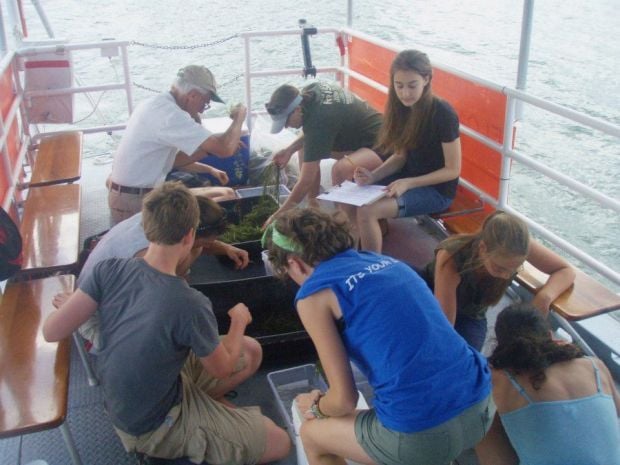

Sorting plant samples
2012 hydrilla monitoring on Cayuga Lake.
There are methods for controlling hydrilla on Cayuga Lake, however, and so far it has not been spread to the Great Lakes. We at Discover Cayuga Lake are working with Bob Johnson, a research scientist, monitoring the lake for hydrilla, using rake tosses along the shores to pull up and identify aquatic plants. Additionally, there is an air boat that goes along the shore by Stewart Park spraying herbicides into the shallow waters to try to control the spread there.

Tuesday, June 9, 2020

NYS Invasive Species Awareness Week


Did you know that our lake and watershed are home to some 15 to 30 invasive species? Woah!

Invasive Species Awareness Week - SLELO PRISM

But what is an invasive species and why might there be a week in our state devoted to learning more about them? Learn more about invasive species awareness week here!


New York To Hold Sixth Annual Invasive Species Awareness Week | WAMC

Efforts underway to control parasitic sea lampreys | WBFO
Sea lamprey and its bite mark in a fish.
An invasive species is any species that was brought to an ecosystem from someplace else and takes over, out competing native species. In our watershed we have many species of carp, gobys, lampreys, zebra and quaga mussels, rusty crayfish, hydrilla, eurasian water milfoil, and many other species which were brought here and are now part of our lake ecosystem.


Eurasian Watermilfoil — Invasive Species of Idaho
Boat propeller caught in Eurasian Water Milfoil.
There are several key species that Discover Cayuga Lake looks at in our programming, both on the boat with the Floating Classroom and in streams with Trout in the Classroom. Normally, this time of year, we would be taking a closer look at some of the invasive species that we see on the boat. In coming days we will highlight individual species and talk about how to find them, how they spread, and why it is important to try to control their influence of our lake and watershed ecosystems. 


Thursday, June 4, 2020

Hidden Hunters

While you might be familiar with the beautiful adult version of this macroinvertebrate, few are aware of its predatory presence in the watery depths. 

Dragonfly and Damselfly Nymphs. Monsters in Shrimp Tanks ...    Dragonfly Larvae | Project Noah

Fully carnivorous, dragonflies are voracious hunters. In their adult phase their aptitude as hunters makes them a hawk among insects, but their hunting is vastly different in their larval stage. Dragonfly larvae are lie-in-wait predators. With a jaw-like lip that extends to catch their prey, they have no need for pursuing their prey, so they hide and let their prey come to them. In their far less beautiful larval stage, dragonflies are designed for camouflage and are mostly grey and brown (though some are green). 

Check out the first 3 minutes of this video to watch a dragonfly larva eat! 


Not only are dragonfly larvae less beautiful, but they also breathe through their butt! That's right, their gills are located inside the rear end of their body and they bring water in and out through their butt to breathe. This interesting adaptation allows them to quickly propel themselves short distances using bursts of water blown out their hind end, suggesting that perhaps a better name for this post would be "ferocious farters." 

Tuesday, June 2, 2020

Aquatic Architects


Did you know that there is an aquatic macroinvertebrate that produces silk much like silk worms or spiders do? But this silk is different... it allows the larvae to build fantastic cases for themselves as protection in the streams, rivers, and lakes they call home.

Caddisflies: Underwater Architects | Articles | FeaturesSequatchie caddisfly larvae, up close. David Withers, TDEC… | Flickr

Check out this caddisfly larva building a case and learn about how it's silk works!


Caddisfly larvae can be anywhere from 3 mm to 40 mm in length (for reference the width of a pinky finger is typically about 10 mm) and, as you saw in the video, they tend to move around by crawling much like a hermit crab. Caddisflies lay their eggs on plant leaves near the water, so that when the larvae hatch, they fall into the water and begin building their cases for protection. This macroinvertebrate has 4 life stages: eggs, larvae, pupa, and adult. In the pupal stage, the caddisfly encloses itself in its protective case underwater (much like a caterpillar would on land) and undergoes its metamorphosis to the adult winged stage.
Unknown adult caddisfly from California - BugGuide.NetCaddisfly Eggs | Trichoptera egg clutch on grass leaf 10 mm … | Flickr


Friday, May 29, 2020

Identification and Cool Facts on Macroinvertebrates!

Did you know what a Crane Fly Larva looks like or that it can stretch up to 4x its average length?


What?! Soooo coool!! Check out more cool macroinvertebrates and investigate what they mean for stream health and how to look for them on your own in our slideshow.


Tuesday, May 26, 2020

Macroinvertebrates Week!

I'm sure you've already seen some of the cool critters that live in streams in our videos, but that's not enough. We are going to give them the food web highlight they deserve!


Typically before we release our trout we bring macroinvertebrates into our classes, so this week we'll be highlighting that lesson. As we begin, we have a cool video to share with you. This 10 minute video will fill you in on some of the background of aquatic insects and give you an idea of what to look forward to in the coming days. 


Keep an eye out for upcoming cool lessons, including how to make your own macroinvertebrate trap!

Friday, May 22, 2020

Did you know trout burp?!

Hi everyone,

Check out this video of a trout burping and keep reading to find out how it works!

Ever wondered how your trout can move up and down in their tank or in a lake? It may seem as simple as them just swimming up or down, but the physics are actually much more complicated. Water has different densities and more or less pressure at different depths, so your trout has to adjust as it moves through a water column (if you think about your body of water as an excel sheet, the column is the up and down dimension).

Your trout moves through the column of water by adjusting its buoyancy (fancy word for how much it floats or sinks). To adjust to different depths of water and change between them, your trout has a swim bladder. This swim bladder can fill with air to make the trout more buoyant, so that it floats, or less buoyant, so that it sinks. Swim bladders can be found in trout and salmon and are connected to their throat, so they can pull air into and out of them as they breathe (it's a little like you closing off your lungs when you swallow so you don't pull liquid into them). To release the air the trout burps, like you would after drinking a lot of soda.

Sometimes when a trout is caught in deep water it doesn't have enough time to adjust its swim bladder before it comes to the surface, when that happens you can have to manually burp the trout, as in the video above. If the trout doesn't burp and you release it, it will float belly up if it has too much air in its swim bladder, and can die before it's able to release the air.

You can check out a trout burping in person next time you're fishing with your family!


Wednesday, May 20, 2020

Final Classroom Trout Releases!

We released the last of our trout today! 


This morning on a live zoom with the ScienCenter we released brown trout into Cascadilla Creek by Thompson Park downtown and this afternoon we released brook trout at Lower Robert H. Treman State Park as part of our Giving is Gorges funding campaign.


In the videos you will see us using a macroinvertibrates identification guide and hear us assessing the stream's health. Both these resources can be beneficial if you want to go out to your nearest creek or ditch and assess its health. We will also be posting some cool ways you can sample for macroinvertibrates that don't involve fancy nets like the ones we had in the videos.

You'll notice we're using masks and distancing in our videos, we recommend you do the same. Now get out there and enjoy the outdoors!


Sunday, May 17, 2020

The 365

When your hiking in the mountains, its a great experience to get to the summit and be able to see in all directions.  You can turn in a complete circle, 365 degrees, and nothing blocks your view.  That's a pretty special feeling.  

See the source image
We have lots of hills in the Finger Lakes, but you won't find many of those 365 views.... unless you happen to hike down into a gorge.  That's right!  One of my favorite things about hiking in our neck of the woods is finding an actual hill within a gorge. 

Usually, when you climb to the top, you'll be underneath the tall trees, so you'll have lots of visibility.  Its not quite Mount Everest, but you'll be able to see what's going on below you in all directions. 


Over thousands of years, and many glacial episodes, our creeks have shifted many times within their gorges.  These high narrow hills are usually the result of a catastrophic event within that long history, and I figured there might be a common name for them.   When I searched "hills within gorges" online, I didn't get a name for these landforms, but just about every page had a reference to Ithaca!  

This is a picture of the path leading up to one of my favorite "mini 365s" at Upper Buttermilk State Park.   I also know of two in Six Mile Creek Preserve, several at Robert Treman State Park and one at Lick Brook.   Can you find a new one for me?


Thursday, May 14, 2020

Trout release at Virgil Creek


Hey Everyone!
Yesterday, I collected trout from Leo Guelpa and Ashley Munson's tanks at Dryden Elementary.  These intrepid teachers were banking on school reopening and held onto their trout like champs.  Alas, reopening was not to be... but I had a chance to release well over 200 beautiful little brook trout.  I thought I'd share... we'll start in Mr. Guelpa's classroom:


Once we got the tanks all cleaned up (Thanks Mr. G!), I headed to the Dryden Rail Trail, where it crosses Springhouse Rd.  

I walked about 100 meters in to a bridge over the creek.. and founda  spot I thought they'd really like.


Now, the Dryden Rail Trail is open to everyone.  Its a great place for a hike or a bike ride, and if you go, I bet you can spot some of the little trout, if the water is clear.  


You'll be glad to know, there were lots of mayflies and scuds (like little freshwater shrimp!) in teh stream, and our trout went right after them.  This one even had part of a worm sticking out of its mouth!

I think they'll be just fine!  Let us know if visit the spot and find them.  Take a picture and send it in to me at floatingclassroom@gmail.com.
~Bill